

 Current position >About Us
Gas Flow Meters: Multi-Variable Mass and Volume Measurement for Utilities
Quick Answer: Multi variable gas flow meters reduce billing errors and sensor count because they measure mass flow, standard volume, temperature, and pressure in one spool piece. Silver Automation Instruments supplies thermal mass, multivariable vortex, and Coriolis gas flow meters for utility gas lines from DN15 to DN200. Send your pipe size, pressure, temperature, and flow range to get a model matched to your site.
Gas networks do not run at constant pressure or temperature. Natural gas pressure changes from morning to night. Biogas temperature changes with digester load. Compressed air load swings when shifts change. A volume only meter may read 500 m³/h at 6 bar and 20 °C. That same actual volume at 8 bar and 35 °C is not the same standard volume. Billing systems need standard volume in Nm³/h or mass flow in kg/h.
Multi variable meters solve this inside the electronics. They read pressure from an internal sensor, temperature from a PT100 or thermocouple, and compute mass flow and standard volume in real time. The output is 4-20 mA HART, Modbus RTU, or both. In practice, most engineers skip this part. They install a volume meter and add a separate pressure transmitter and flow computer. That works. That approach adds wiring, calibration points, and failure modes.
Meter Types for Utility Gas Lines
Silver Automation Instruments offers three common types for utility gas measurement.
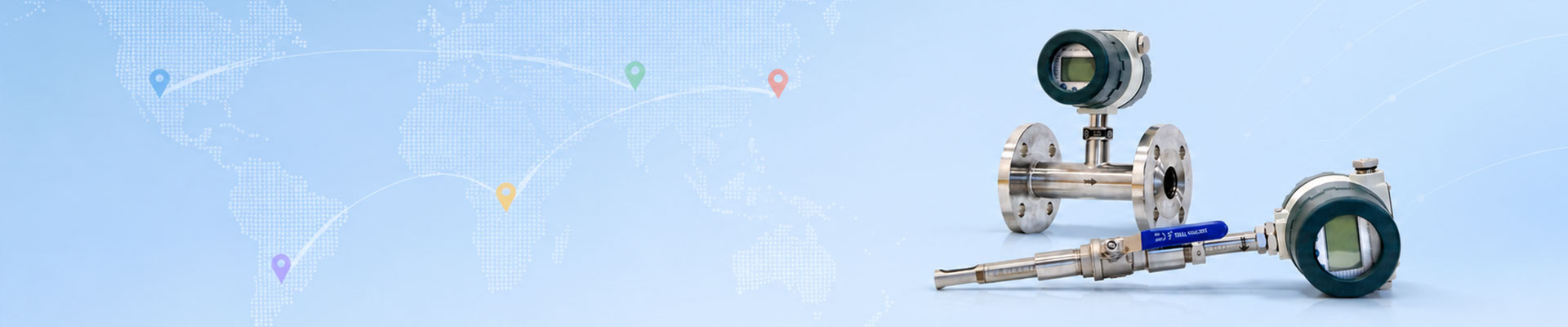
Multivariable vortex flow meters work well for steam, natural gas, and compressed air above 2 bar. They have no moving parts. They measure mass flow, standard volume, temperature, and pressure in one body. Standard accuracy is 1.0 percent of rate for gas, and 1.5 percent for steam depending on Reynolds number. For most utility gases, viscosity stays below 0.05 cP, which keeps the Reynolds number high and the shedding stable.
Thermal mass flow meters suit low pressure biogas, flare gas, compressed air, and nitrogen. They install directly in line or by insertion. For a DN50 biogas line at 0.2 bar and 35 °C, a thermal mass meter reports kg/h and Nm³/h without a separate pressure transmitter. It does not compensate for pressure changes, so use it on lines with stable pressure or measure mass directly.
Coriolis mass flow meters are the choice for high value gas or custody transfer. They report kg/h, density, and temperature. They cost more. Pipe sizes from DN15 to DN100 are common. A gas utility that needs 0.5 percent accuracy on natural gas injection into a city grid may justify Coriolis.
Utility Applications From Customer Sites
We have seen this on customer sites many times. A natural gas utility in Malaysia had a DN80 line at 8 bar. Flow ranged from 60 to 600 Nm³/h. A volume only meter was affected by pressure drops at peak hour. The replacement was an inline multivariable vortex meter with integrated pressure and temperature compensation. It output mass flow and standard volume over 4-20 mA HART.
A wastewater plant in Vietnam used wet biogas from digesters. The pipe was DN50 at 0.3 bar. H2S levels were moderate. The plant chose a thermal mass flow meter with 316L wetted parts and PTFE gaskets. It measured biogas flow in Nm³/h and kg/h for boiler fuel ratio control. The probe was installed with a 10 D straight run upstream.
A food and beverage factory in Indonesia measured compressed air in a DN150 header. Pressure varied from 6 to 8 bar. They used an insertion thermal mass flow meter. The plant wanted total consumption per shift to find leaks. The meter sent Modbus RS485 data to an energy monitoring system. Within one month, the maintenance team found three leaking pneumatic actuators.
A chemical plant in Thailand measured superheated steam at 12 bar and 190 °C. They used a multivariable vortex meter on a DN100 line. The