

『Coriolis Effect in Flow Meter: Physics of Direct Mass and Fluid Density Measurement』Related information(v cone flow meter|rotary gas meter|gallon meter|gear meter|metal tube rotameter|glass tube rotameter|nutating disk meter|transit time ultrasonic flow meter|wedge flow meter|pd meters|hydraulic flow meter|ultrasonic water flow meter|water flow meter|air flow meter|magnetic water flow meter|oxygen flow meter|gas flow meter|argon flow meter|air velocity meter|gasoline flow meter|fuel flow meter|ultrasonic water meter|digital water meter|nitrogen flow meter|solid flow meter|Oxygen tank flow meter|digital water flow meter|diesel fuel flow meter|steam flow meter|02 flow meter|compressed air flow meter|oil flow meter|liquid flow meter)
Coriolis Effect in Flow Meter: Physics of Direct Mass and Fluid Density Measurement
Quick Answer: The Coriolis effect in a flow meter gives a direct mass flow signal and a live fluid density signal from one sensing element. This removes separate density compensation for many liquid and gas measurement jobs. Silver Instruments supplies Coriolis mass flow meters from DN15 to DN300 for batching, custody transfer, blending, and inline concentration control.
How the Coriolis Effect Works in a Flow Meter
When a tube vibrates and fluid flows through it, inertia from the moving fluid creates a phase shift between the inlet and outlet pickup coils. The size of this phase shift is proportional to direct mass flow. The transmitter converts the phase shift into kg/h, t/h, or lb/min. The same sensor also measures the tube natural frequency. The frequency changes with fluid density. That gives a live density value in kg/m³, g/cm³, or °Brix.
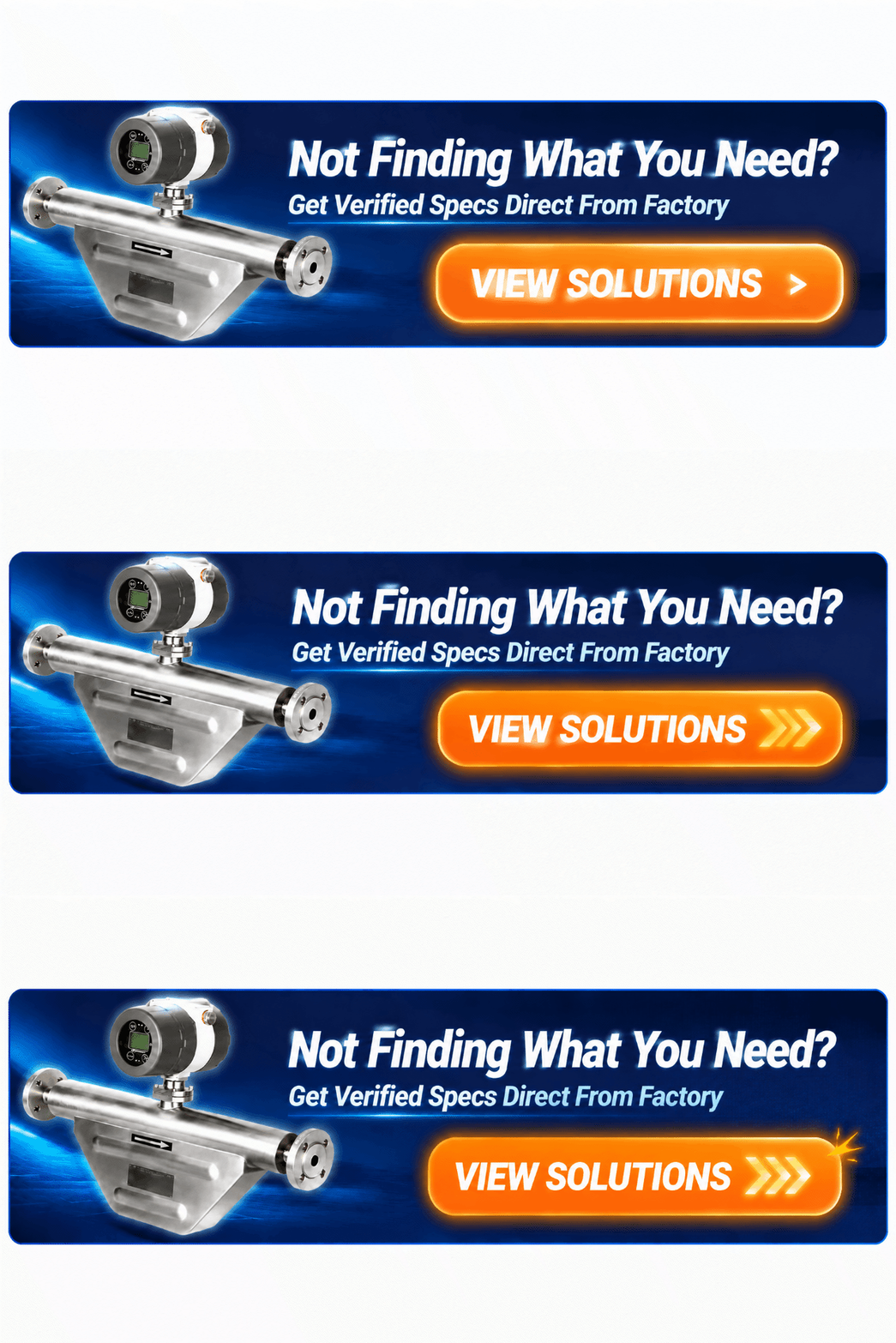
In practice, the meter has one or two flow tubes made from 316L stainless steel, Hastelloy C22, or titanium. A drive coil keeps the tube excited at a controlled frequency. Two pickup coils detect the sine wave movement. A built-in PT100 measures temperature. The transmitter converts all signals into 4-20 mA HART, pulse, Modbus RTU, or Modbus TCP.
Direct Mass Flow vs Volumetric Flow
Most flow meters measure volume. The Coriolis effect measures mass because the phase shift depends on fluid inertia. A volumetric meter often needs pressure and temperature inputs to correct density. A Coriolis meter does not need that correction for mass flow. For example, diesel at 35°C and diesel at 80°C have different volumes but the same mass flow if the kg/h rate is constant. A Coriolis meter reads the mass flow directly.
This matters in fuel loading, chemical dosing, and batch blending. A customer in Vietnam replaced two turbine meters with one Silver Instruments Coriolis meter for marine fuel oil batching. The new meter removed the density correction step and reduced batch error to under 0.15 percent.
Fluid Density Measurement in the Same Meter
Because the tube natural frequency moves with process fluid density, the transmitter calculates density on every scan. Engineers get two process variables from one field device. A syrup blending plant in Thailand uses the density output as °Brix to control sugar concentration. A chemical plant in Mexico uses density to verify acid concentration before a reactor charge.
Typical liquid density accuracy for a Silver Instruments Coriolis meter is 0.0005 g/cm³. Temperature accuracy is around ±0.5°C from the built-in PT100. Some users monitor both mass flow and density to detect two-phase flow, air slugs, or product changeover.
Common Industrial Applications
Crude oil and refined fuel loading in Malaysia uses mass flow in kg/h and density converted to net volume at 15°C. Paint and resin production in Southeast Asia uses Coriolis meters for precise hardener and solvent dosing. Food and beverage plants in Indonesia use the °Brix output for syrups and concentrates. Wastewater treatment sites in Australia use Coriolis flow me

Sizing, Installation, and Outputs
Sizes from DN15 to DN300 cover most process lines. Larger sizes are available on request. Pressure ratings up to PN100 or ANSI 600 are common. Process connections include flange, tri-clamp, and thread types. Here is the thing. Coriolis meters do not require long straight runs. However, you must support the meter properly and avoid cavitation. For liquids with high vapor pressure, keep enough back pressure. Zero the meter at operating temperature after installation. Most engineers skip this part when they are in a hurry, but a hot zero check will improve low flow accuracy. We have seen this on customer sites many times.
Typical liquid mass flow accuracy is 0.1 percent of rate. Gas mass flow accuracy is 0.35 percent. Repeatability is around 0.05 percent. Turndown ratio can be 20:1 or higher. The transmitter can output 4-20 mA HART, pulse, or Modbus. Hazardous area options include ATEX Zone 1 and IECEx. Enclosure ratings up to IP66/IP67 are available for washdown and offshore skid areas.
Silver Instruments Support and Quote Request
Silver Automation Instruments supplies Coriolis mass flow meters for process plants, skids, and remote sites across Southeast Asia, Oceania, Latin America, Africa, and the Middle East. We support end users and distributors from 10 to 100 people. Send us your fluid name, density range, viscosity in cP, flow range in kg/h, pressure in bar, temperature in °C, pipe size DN, connection type, output signal, and hazardous area zone. We will reply with a recommended model, accuracy details, and a price quote.
Contact us directly:
Tel: +86-135-1213-1526
WhatsApp: 86-135-12131526
WeChat: +86 13512131526
Website: https://flow-meter.com.au
FAQ: Coriolis Effect and Direct Mass Flow
Does the Coriolis effect in a flow meter measure mass flow directly?
Yes. The phase shift between two pickup coils is proportional to mass flow rate. The transmitter converts this phase shift into kg/h or t/h without external density compensation.
Can a Coriolis flow meter measure fluid density at the same time?
Yes. The vibration frequency changes with density. The meter outputs density in kg/m³, g/cm³, or °Brix as a secondary variable.
What sizes does Silver Instruments supply?
Standard sizes run from DN15 to DN300. Connections include flange, tri-clamp, and thread types. Larger sizes are built on request.
Which fluids need special review before quoting?
Gas at very low density, high two-phase flow, abrasive slurries, and very high viscosity fluids above 1,000,000 cP need special sizing. Send the process data and we will check the application.
What data should I send for a price quote?
Send fluid name, density range, viscosity, flow range, operating pressure, temperature, pipe size, connection type, output signal, and hazardous area certification.
 Hot Blog
 Related AD